
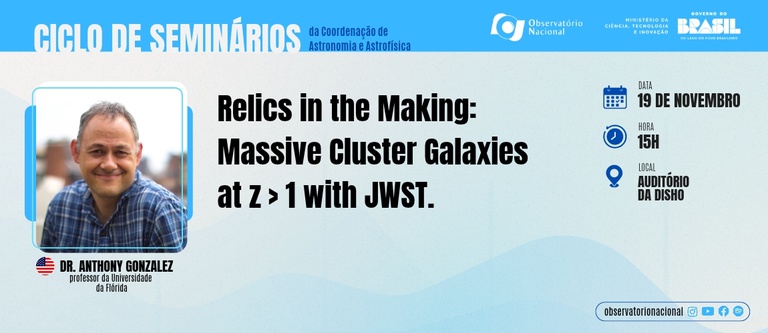
A Coordenação de Astronomia e Astrofísica (COAST) do Observatório Nacional (ON/MCTI) terá na próxima quinta-feira, 19 de novembro de 2026 , mais uma palestra do ciclo 2026 dos seus seminários semanais. A palestra será ministrada pelo Dr. Anthony Gonzalez , professor da Universidade da Flórida. O seminário terá como tema “Relics in the Making: Massive Cluster Galaxies at z > 1 with JWST” e será realizado presencialmente no Auditório da DISHO, às 15h. O coffee break será realizado após a apresentação, às 16h. Anthony Gonzalez (Professor da Universidade da Flórida). Data e hora: 19 de novembro de 2026 , às 15h (Coffee break às 16h).
Título: Relics in the Making: Massive Cluster Galaxies at z > 1 with JWST. Resumo: Galaxy clusters are the most overdense environments in the Universe, and the places where the first and most massive galaxies form. JWST spectroscopy, combined with new samples of distant clusters, now lets us study cluster galaxies in the first half of cosmic history with a precision previously associated with the nearby Universe. We can see these systems at the epoch when the first clusters have only recently assembled and their stars are only a few billion years old. In this talk I will present results from two ongoing JWST programs.
The first project is designed to measure the stellar initial mass function in massive galaxies ~9 Gyrs ago and test whether the IMF is similar to that of the Milky Way or more bottom-heavy, as has been argued for nearby massive ellipticals. The second project asks what drives the environmental quenching of star formation, leading to the predominantly passive galaxy population in local clusters. By focusing on a cluster at a lookback time of 10 Gyrs, we are able to more robustly constrain the quenching timescales and physical mechanisms responsible.
I will close with prospects for extending cluster studies to higher redshifts and much larger samples with Euclid and Roman. Bio: Anthony Gonzalez is a Professor in the Department of Astronomy at the University of Florida (UF). After earning his PhD in Astronomy and Astrophysics from the University of California, Santa Cruz, in 2000, he spent a year at the Harvard-Smithsonian Center for Astrophysics as a CfA Fellow, followed by three years at UF as an NSF Astronomy and Astrophysics Postdoctoral Fellow. He joined the UF faculty in 2005.
His research focuses on how structure grows and evolves in the universe, with an emphasis on the evolution of galaxies and galaxy clusters.
 Uberlândia: Settran informa linha especial para atendimento aos estudantes que vão assistir ao segundo dia do Aulão do Enem 2026
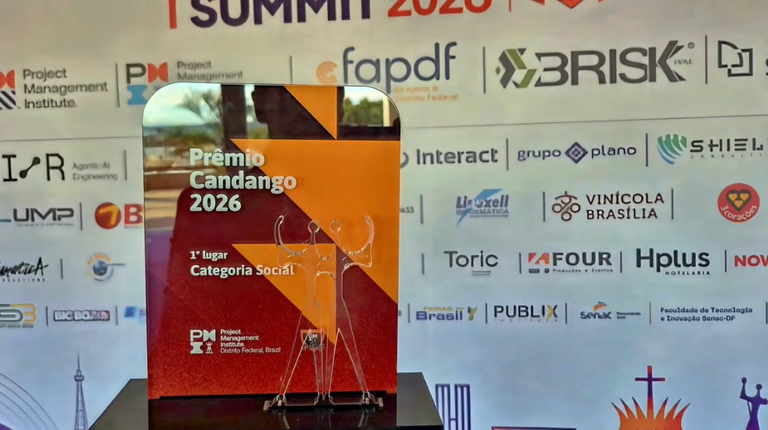 Internet Brasil vence prêmio nacional por ampliar acesso à internet entre estudantes de baixa renda
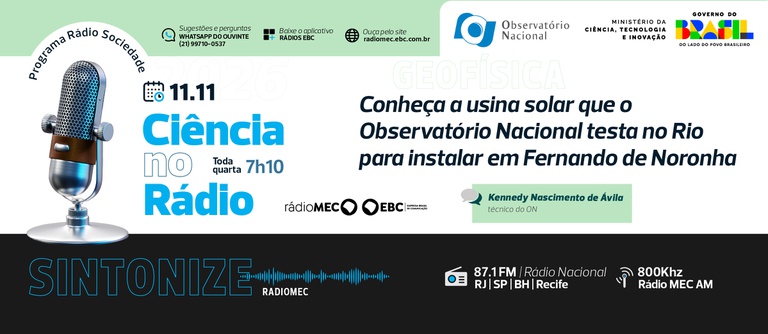 Ciência no Rádio explica como funciona a usina solar que o Observatório Nacional instalará em Fernando de Noronha