
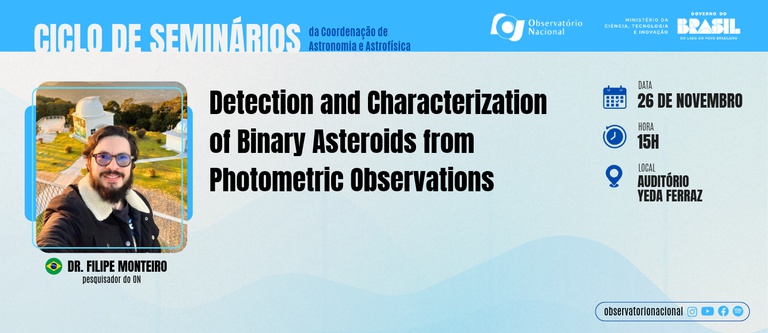
A Coordenação de Astronomia e Astrofísica (COAST) do Observatório Nacional (ON/MCTI) terá na próxima quinta-feira, 26 de novembro de 2026 , mais uma palestra do ciclo 2026 dos seus seminários semanais. A palestra será ministrada pelo pesquisador do Observatório Nacional, Dr. O seminário terá como tema “Detection and Characterization of Binary Asteroids from Photometric Observations” e será realizado presencialmente no Auditório Yeda Ferraz, no ON, às 15h. O coffee break será às 14h30. Filipe Monteiro (ON/MCTI). Data e hora: 26 de novembro de 2026 , às 15h (Coffee break às 14h30). Local: Auditório Yeda Ferraz, no ON.
Título: Detection and Characterization of Binary Asteroids from Photometric Observations. Resumo: Photometric light curve observations have been extensively applied to derive essential physical properties of asteroids and to detect and characterize binary systems. The study of these systems provides unique conditions for investigating the internal structure and composition of asteroids. Current observational evidence suggests that small binary systems (D = 0.2–10 km), both in the main asteroid belt and in the near-Earth region, may form through rotational fission of reaccumulated bodies, likely driven by the YORP effect.
In this context, we have conducted photometric observations at several observatories, including the Astronomical Observatory of Sertão de Itaparica (OASI, Brazil), the Blue Mountain Observatory (BMO, Australia), and the Observatorio Astronómico Nacional de San Pedro Mártir (OAN-SPM, Mexico). The analyzed targets belong to both the Near-Earth Object (NEO) and Main-Belt asteroid populations and were observed with the aim of detecting and characterizing binary systems.
The derived physical properties include rotational and orbital periods, spin-axis orientations, shape models, effective diameters, absolute magnitudes, color indices, and photometric spectra. The seminar will discuss the methodologies employed in the detection and characterization of binary systems from photometric light curves, highlighting how multi-epoch observations can be used to constrain rotational states, pole orientations, and three-dimensional shape models.
For the observed binary systems, photometric analyses also allowed the determination of component size ratios, orbital parameters, and average densities, providing important constraints on their internal structure and formation mechanisms. These results contribute to our understanding of the origin and evolution of binary asteroids and demonstrate the importance of long-term photometric monitoring and international observational networks for the study of small bodies in the Solar System.
 Observatório Nacional participa da 23ª SNCT em Brasília com programação voltada ao tema "Ciência Delas"
 Governo enfrenta pendências no Congresso antes do recesso legislativo
 Sesc-DF celebra mês da Consciência Negra com arte e cultura